
——For retail buyers and merchants——
Stop guessing on price.
Stop over-assorting.
Start selling through.
Palette tells you what to price, what to keep, what to cut, and when to act — with evidence behind every recommendation. It gets sharper every cycle and empowers your Open-to-Buy / Line Strategy decisions.
Price with Precision
Simplify with Confidence
See What's Next
Every recommendation — every price, every keep, every cut — shows its reasoning.
How Palette Works
At the core of Palette is Sherlock, a fully-custom AI engine. Every opinion Sherlock forms is explicitly evidence-based — evidence compounding on evidence, cycle after cycle. As it becomes more familiar with your business, it develops strong convictions about what works and what doesn't, and sets expectations for what will happen next.
When your actuals align with those expectations, conviction strengthens. When they defy expectations, Sherlock reasons through the source of the difference and revises its stance based on the new evidence.
It doesn't start over from scratch. It doesn't retrain on your entire history. It reasons — like its namesake — from models it's built, and revises only where challenged. Each time you flip a Product Card in Palette, it's akin to the great detective rounding everyone up and explaining what's what.
Your data is processed and returned.
The intelligence stays.
The data doesn't.
Alongside Sherlock is Cadence, its fully-custom counterpart. It takes in all accumulated knowledge from Sherlock, observes all available evidence per every combination of product and geography and timing — and decides if it's best to leave something alone… or to act. Its goal is to intervene as little as possible. Where it counts, where there's evidence for a far better outcome.
But, beyond these moments of action, Cadence also provides new evidence: Where did it have to intervene? How hard did it have to? Each action it takes is a new signal, new evidence for Sherlock to dissect.
This isn't about simply keeping the lights on or making do with what is there. It's about forming new opinions that can help build a better lightbulb in the future — the sort of things you need to know when thinking about what's next. Together, the two form a continuously improving system that finds opportunity at every step.
Because it's not just about doing better right now.
It's about doing even better next time.
As well as the time after.
A Different Kind of Platform
Most retail optimization vendors share the same architecture... and limitations.
What Merchants See
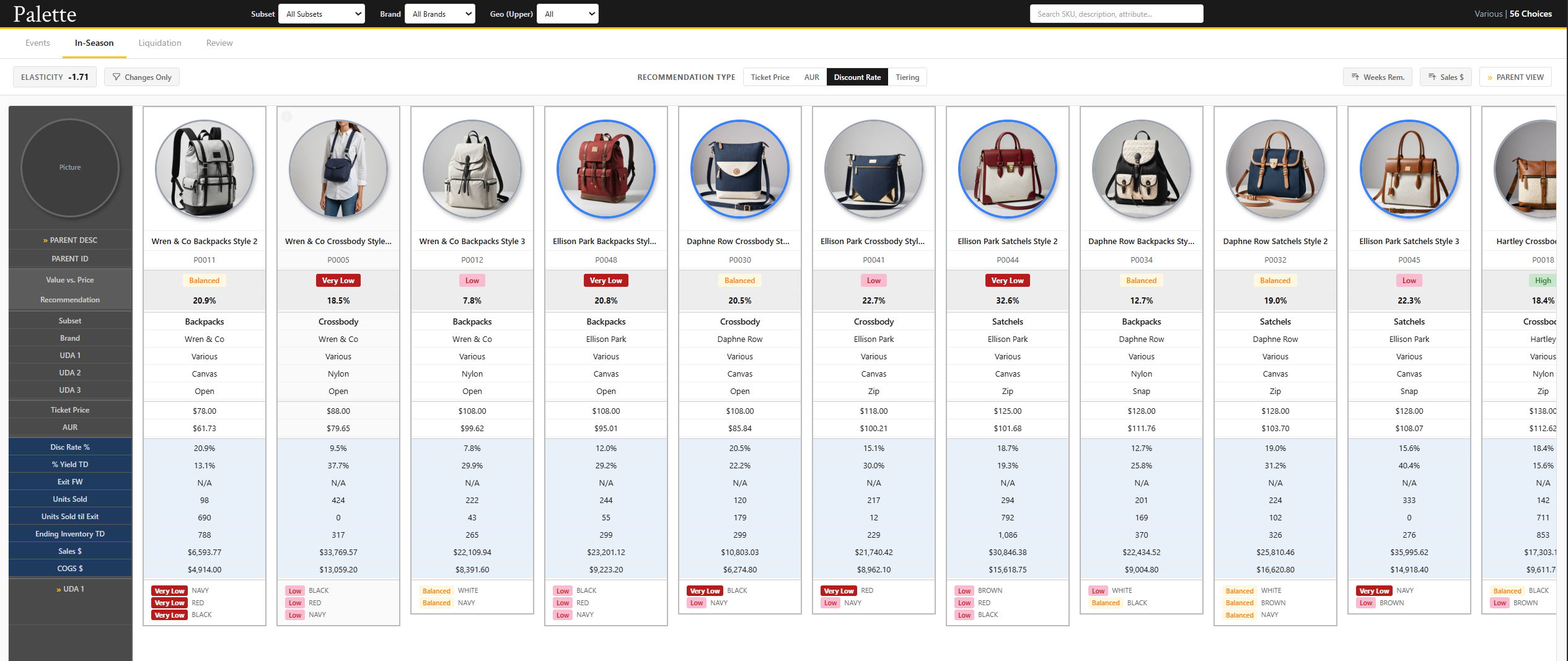
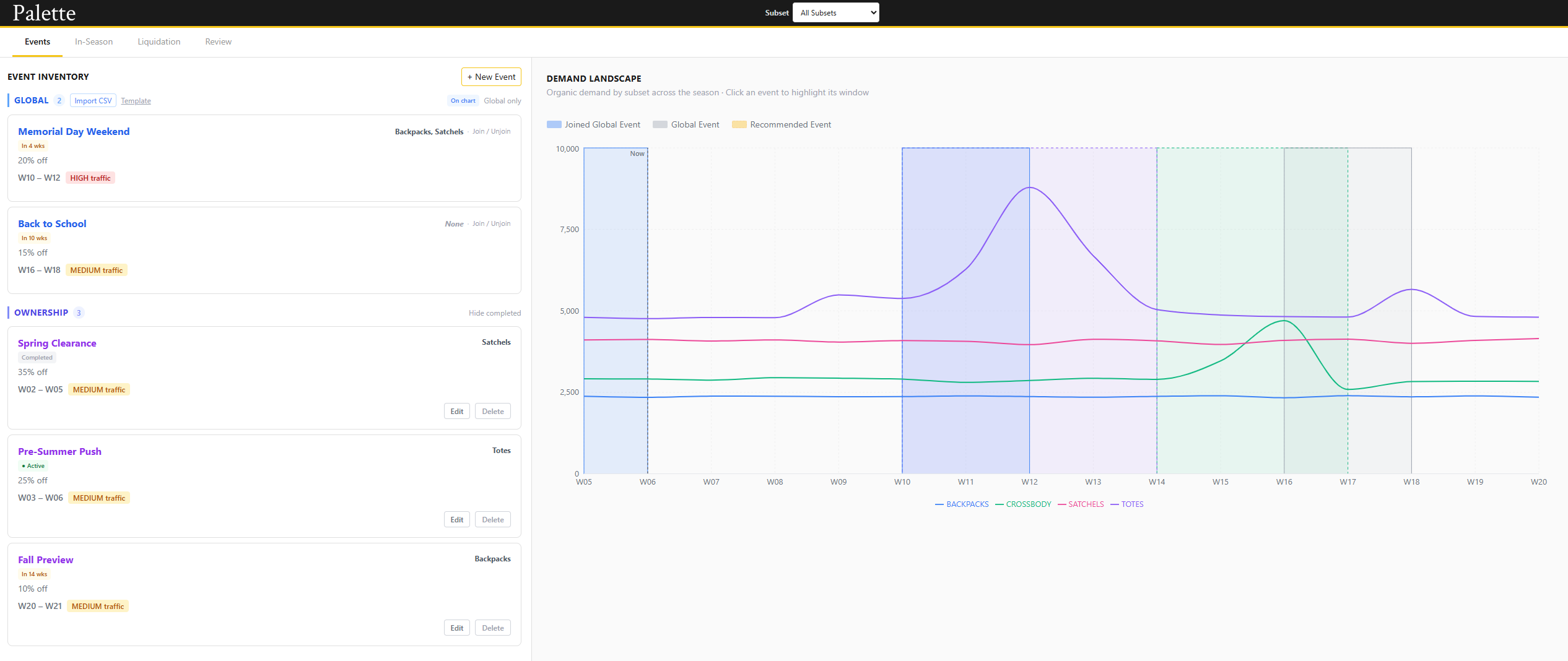
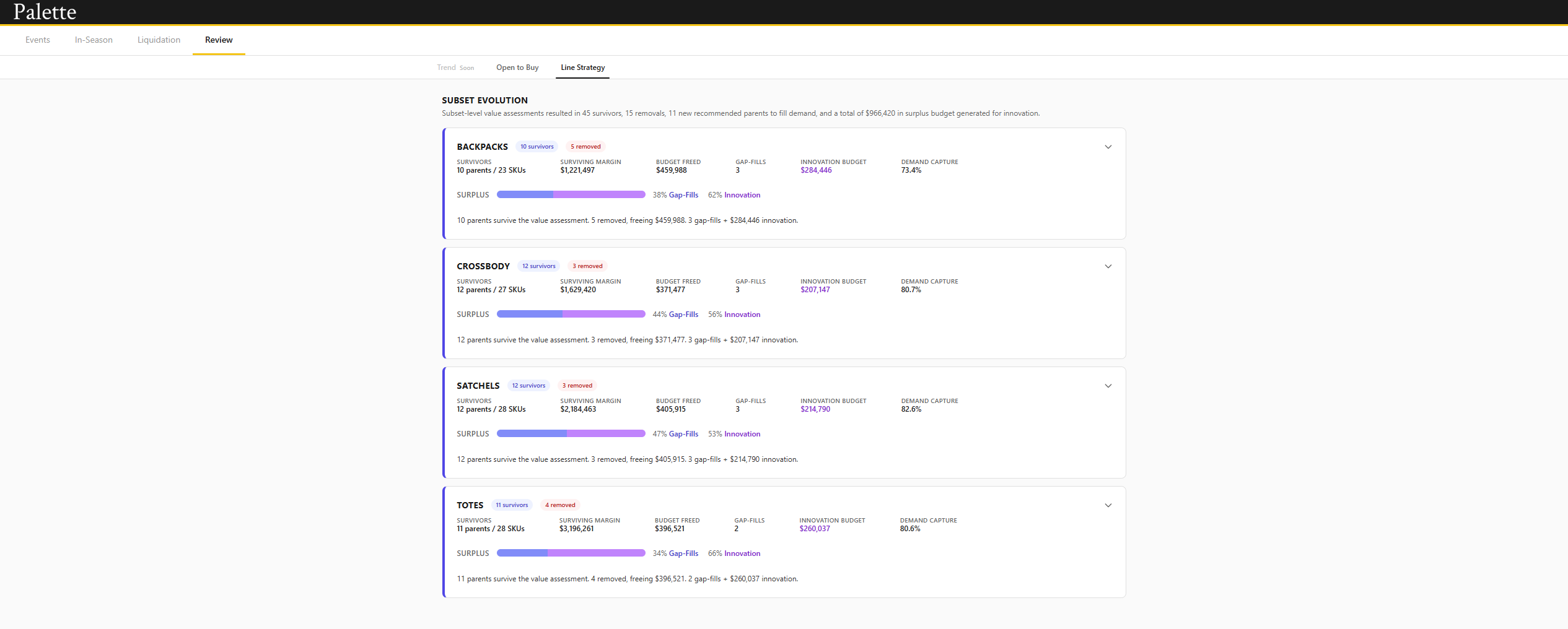
This is the actual Palette portal. Every card is a product. Every metric traces to a specific analytical finding.
Tap to expand
Simple pricing. Full platform.
Every tier gets the same intelligence. We don't charge for features. We charge based on the scale of the business we're serving.
| Retailer Type | Annual Revenue | Annual Fees |
|---|---|---|
| Emerging | $10M – $100M | $120K |
| Growth | $100M – $500M | $300K |
| Enterprise | $500M – $2B | $600K |
| Premier | $2B – $5B | $1M |
| Flagship | $5B – $10B | $1.5M |
| Titan | $10B + | $2M |
Every tier includes the full platform
No feature gating, no module upsells. No nickels, no dimes.
Weekly Analysis of Your Entire Assortment
Every SKU, every store, every attribute — pricing, sell-through, and rationalization in one pass. A comparable single-category review from a consultancy runs $75K–$200K and delivers a static snapshot. Palette does it every week, across all categories, and it gets sharper each cycle.
Explainable Recommendations
Every price, every keep/cut/review, every chase/maintain/exit decision traces to a specific reason. No black box.
Cross-Category Trend Analysis
Rising and fading attributes surfaced across your business, not siloed within departments.
Promotional Event Planning
Seasonal demand detection, product-level tier assignments, offer and timing optimization together.
Accumulating Intelligence
Elasticity estimates, track records, and attribute signals sharpen with every cycle thanks to Sherlock, our custom AI engine.
48 Hours of Realtime Mode
Hourly analysis and opt-in execution during your most critical selling windows.
Near-Zero Data Retention
Palette retains only the most recent week’s raw data to ensure the portal reflects your immediate reality, and that raw data gets overwritten every week when we receive your next file.
Higher tiers add dedicated onboarding support, quarterly business reviews, priority roadmap influence, and named support contacts. Not additional features. Palette doesn't charge more for more intelligence.
2-Month Pilot — Try Before You Buy
2-month pilots start at $15K for Emerging retailers and scale with tier — the same proportional commitment at every level.
Week 1
Palette prices your assortment. Full reasoning on every recommendation. You execute.
Weeks 2–3
Results come in. Palette refines its estimates based on observed outcomes.
Weeks 4–8
Palette is learning your business. Recommendations sharpen. Trends emerge.
By the end of Week 8, you're
not evaluating Palette.
You're using it.
Your pilot investment applies in full toward your first annual contract.
The pilot isn't a test. It's the beginning.
Frequently Asked Questions
How long until we see results?
It depends on how quickly your team can provide data. There’s typically a short onboarding period — aligning on how data should be formatted, defining business logic like product hierarchies and subsets, and establishing your first weekly feed. For a pilot, that prep work usually takes a couple of weeks. For a full enterprise-wide implementation, expect 2–3 months. Once data is flowing, Palette produces actionable recommendations from the first submission.
What data do you need?
We only need a weekly snapshot: SKU details, sales, inventory, costs, attributes. Your ERP already has this. We provide a template to expedite things. However, we’re able to surface additional pieces of data — competitive pricing, review information, etc. — within the Product Cards where that would be helpful. It’s really up to you what you want to see to help you materially make decisions.
Do you store our data?
Palette retains only the most recent week’s raw data so the portal reflects your immediate reality — and that gets overwritten every week when we receive your next file. What persists is Palette’s accumulated intelligence: elasticity, pricing behavior, sell-through trajectories, and attribute trends. Your data stays yours. Palette keeps what it learned, not what it was given.
What if we want to leave?
There’s nothing to migrate, unwind, or extract. Palette doesn’t embed itself in your systems. Every contract includes an early termination clause — if it’s not working, you can exit. Accumulated intelligence is deleted and you walk away clean.
How is this different from legacy optimization vendors in retail?
Those platforms require years of historical data, 6–18 months of implementation, and $2–5M annually. Palette works from day one, explains every recommendation, doesn’t warehouse your data, and costs a fraction — not because we do less, but because our architecture doesn’t need what theirs does.
Does this require IT involvement?
Palette’s data spec is simple enough that most teams can produce the file themselves from their existing ERP or BI tools. In the bulk of ongoing enterprise engagements, however, it’s probably best for a short IT sprint — alongside our own implementation team — to make sure everything is what it needs to be, when it needs to be, where it needs to be.
Does Palette integrate with our POS / ERP / planning system?
Palette works from a single flat file: SKU details, sales, inventory, costs, and attributes. No direct integration is required. Most retailers already have this data available in their ERP or BI tools. If an automated weekly feed makes sense, our implementation team can work with yours to set that up.
What if Palette recommends something we disagree with?
Every recommendation comes with the evidence behind it — sell-through pace, elasticity, margin analysis, and constraint logic. You can accept, modify, or ignore any recommendation. Palette informs your decisions. It doesn’t make them for you.
How does Palette handle markdowns differently than our current process?
Palette evaluates sell-through pace, margin floors, competitive position, lifecycle urgency, and remaining weeks — simultaneously, for every SKU. Most manual processes optimize one variable at a time. Palette holds the full picture so your team doesn’t have to.
What size retailer is Palette built for?
Any retailer with 200 or more active SKUs and weekly sell-through data. Palette scales with assortment and geographical complexity. More SKUs, more doors, more subsets mean more intelligence to accumulate and more recommendations to produce. Pricing tiers are based on annual revenue as a proxy for that complexity, not because features are gated behind higher tiers. Every client gets the full platform.
Can Palette handle multiple categories or divisions?
Yes. Palette evaluates products within whatever hierarchy you define — handbags, apparel, electronics, home goods. The methodology adapts to the assortment, not the other way around.
Is our data secure?
Data is transmitted over TLS, processed in isolated environments, and never commingled across clients. Palette retains analytical signals — elasticity priors, trend intelligence, track records — not your raw transaction data. When you stop, everything is deleted.
What Experts Say
“Palette means more knowledge, more insight, more detail, and more clarity — all in less time!”